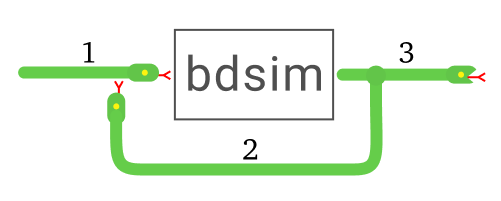
A Pythonic block-diagram environment for the simulation and analysis of dynamic systems.



GitHub • Wiki • Changelog • Installation






bdsim bridges the gap between mathematical block diagrams and executable Python code. Unlike traditional graphical-only tools, it treats modelling as code, allowing you to define, simulate, and analyze continuous-time, discrete-time, or hybrid systems within a modern software engineering workflow. Wires in bdsim aren't limited to scalars; they pass NumPy arrays, dictionaries, or even SpatialMath objects seamlessly through your system, integrating directly with the Robotics and Machine Vision toolboxes.
- Python-First Workflow: Define your systems in pure Python code. Use your preferred IDE (like VS Code), manage versions with Git, and integrate with standard unit-testing frameworks.
- Rich Data Types: Wires in
bdsimaren't limited to scalars. Seamlessly pass NumPy arrays, dictionaries, or complex objects likeSE3andSO3from thespatialmath-pythonlibrary. - Modular & Extensible: Adding new functionality is straightforward. Create custom blocks by simply subclassing the
Blockclass. - Hybrid Ecosystem: Native integration with the Robotics Toolbox and Machine Vision Toolbox for Python.
- Powerful Editor: Includes
bdedit, a PySide-based graphical editor for visual system design and discovery. - Publication Ready: Export diagrams or simulation data to to high-quality formats such as PDF or SVG for use in publications.
You can install bdsim directly from PyPI:
pip install bdsim
To include the graphical editor (bdedit) and its dependencies:

Bash
pip install bdsim[editor]
Install locally with help from the detailed installation guide.
Or skip setup and run the browser-based JupyterLite examples.
The power of bdsim lies in its conciseness. The step response of a simple first-order system can be defined and simulated in just a few lines of code:
Python
import bdsim

sim = bdsim.BDSim()
bd = sim.blockdiagram()

# Define blocks
step = bd.STEP(T=1, pos=1)
plant = bd.LTI_SISO(1, [1, 1]) # 1/(s+1)
scope = bd.SCOPE()

# Connect blocks
bd.connect(step, plant)
bd.connect(plant, scope)

bd.compile()
out = sim.run(bd, T=5)In contrast to traditional graphical simulation tools, bdsim treats modelling as code. This ensures:
-
Better Version Control: No more opaque binary blobs. Your models are searchable, diffable text.
-
Seamless Integration: Incorporate SciPy solvers, PyTorch models, or custom computer vision pipelines directly into your simulation loops.
-
Scalability: Programmatically generate massive block diagrams or run large-scale batch simulations on headless servers.
Full Documentation: https://petercorke.github.io/bdsim/
Wiki: Access the community wiki for deep dives into specific block behaviours and tutorials.